
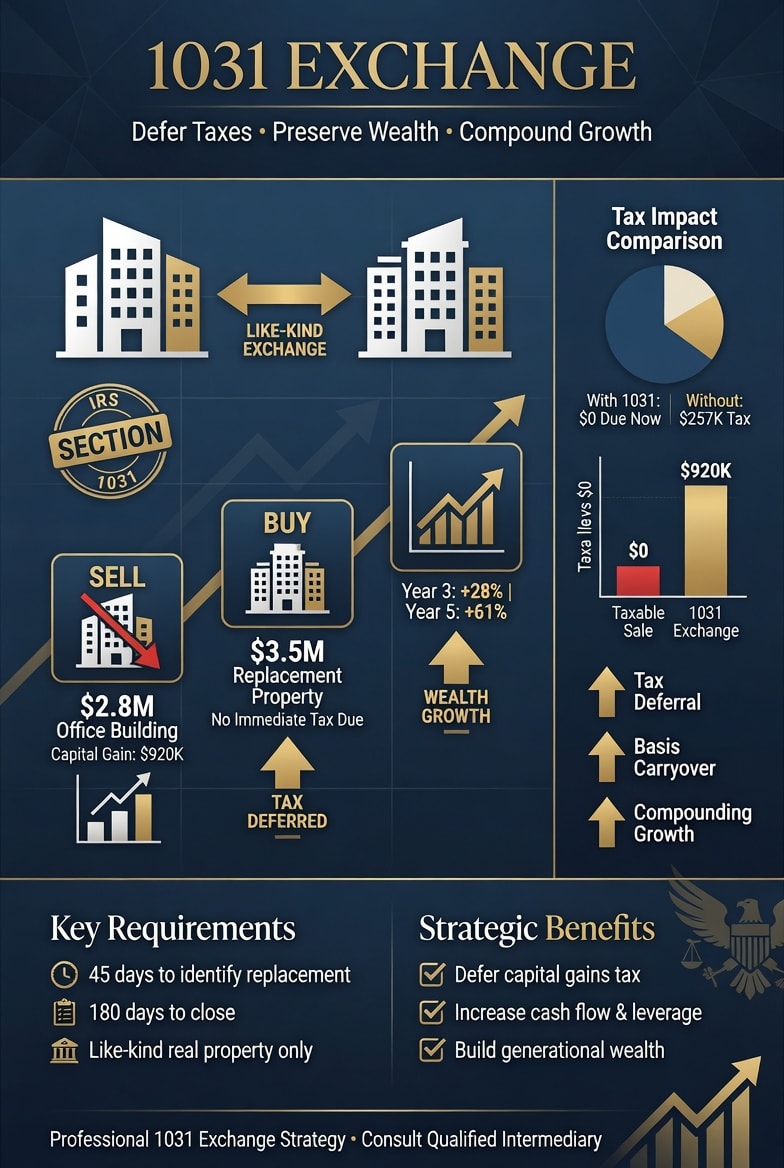

Selling real estate held for investment in Texas can trigger substantial federal capital gains taxes. A 1031 exchange provides a powerful way for Texas real estate owners to defer those taxes by reinvesting the proceeds into another qualifying “like-kind” property, allowing you to keep more capital working in a resilient Texas market.
With no state income tax and steady demand across commercial sectors, this strategy helps real estate owners upgrade, diversify, or consolidate holdings without an immediate tax burden.
What Is a 1031 Exchange? Under IRS Section 1031, real estate owners can exchange one investment or business-use real property for another “like-kind” property and defer federal capital gains taxes. The properties must be held for investment or productive use in a trade or business — personal residences do not qualify.
In Texas, this opens the door to swapping a small retail strip for a larger industrial building, vacant land for an income-producing office property, or one asset for multiple properties — all while deferring taxes.
Key Benefits for Texas Real Estate Owners
- Defer federal capital gains taxes on the sale.
- Reinvest the full pre-tax proceeds into larger, higher-performing, or more diversified properties.
- Take advantage of Texas’s business-friendly climate and population-driven growth without state income tax complications.
- Compound wealth over time through repeated exchanges.
Strict Rules You Must Follow
- Use a qualified intermediary to hold the sale proceeds — you cannot touch the money yourself.
- The properties must be like-kind (real estate for real estate) and held for investment or business use.
- Identify replacement property within 45 days after selling.
- Close on the new property within 180 days.
- Reinvest all equity and acquire property of equal or greater value to fully defer taxes.
How a 1031 Exchange Works – Step by Step
- Sell your relinquished property and direct the proceeds to a qualified intermediary.
- Within 45 days, formally identify up to three potential replacement properties (or more under the 200% rule).
- Close on one or more of the identified properties within 180 days.
- Report the exchange on IRS Form 8824 with your tax return.
Missing any deadlines or violating the rules converts the exchange into a fully taxable sale.
Common Strategies for Texas Real Estate Owners
- Upgrade from a smaller property to a larger, higher-income-producing asset.
- Diversify across different property types or geographic areas within Texas’s growing markets.
- Consolidate several smaller holdings into one premium commercial property.
- Shift toward more passive investments, such as triple-net leased properties.
The Ultimate Estate Planning Advantage: Swap Till You Drop One of the most attractive features of 1031 exchanges is the ability to defer taxes indefinitely. Many savvy Texas real estate owners follow a “swap till you drop” strategy — continuing to exchange properties throughout their lifetime. When you pass away, your heirs receive a stepped-up basis to the current fair market value of the property. This effectively erases the accumulated deferred capital gains tax, allowing you to build and transfer a larger, more tax-efficient legacy to the next generation.
Important Considerations Work closely with an experienced commercial real estate broker and a qualified intermediary from the beginning. Always consult your tax advisor, since partial exchanges or failure to meet requirements can result in taxable gain. Note that 1031 rules apply only to real property — personal property exchanges are no longer eligible.
Wes Miller of W.C. Miller Properties has guided Texas real estate owners through successful commercial real estate strategies for 28 years. Whether you’re looking to upgrade, diversify, or plan for the future, a 1031 exchange can be a game-changing tool.
Ready to explore a 1031 exchange for your commercial property? Contact Wes Miller at W.C. Miller Properties today for a complimentary property valuation and expert guidance on tax-deferred strategies.